1) model-based

模型基
1.
In allusion to form images with the same context, a sepcial method which uses the same context of form images as 2D model and the differentia as moving parameters is proposed according to the model-based coding with moving image.
针对具有相同背景的表格图像 ,借鉴在运动图像压缩中效果很好的模型基压缩方法 ,提出将表格图像的相同背景建立成二维模型 ,将表格图像中的不同内容作为运动参数进行编码 ,解码时再将图像进行合成的方法。
2) basic model
基本模型
1.
A basic model of reaction dynamics consisting of 60 chemical reactions among 19 active compounds,and a simplified model including only 27 reactions were developed for seeking reaction mechanism.
针对实际的过程特征,合理地估计了反应停留时间、电子温度、电子密度作为模拟计算的输入参数,建立了包含19个组分、60个化学反应式的反应动力学基本模型。
2.
The key of the research in Collar's Pattern Auto-generation Expert System is to establish a collar's 3D basic model and to get the 2D structure and pattern of the collar on the basis of this.
衣领纸样自动生成专家系统研究的关键是3D衣领基本模型的建立,并在此基础上得到衣领的2D平面结构,进而生成衣领工业纸样。
3.
The results show that in cases of inhomogeneous topologies with lane droping or high on-and off-ramp volumes the basic model has significant dev.
结果表明,当存在较大的匝道流量冲击或沿途车道数目有改变时,基本模型的误差较大,而改进模型的精度有明显提高。
3) basic-element model
基元模型
1.
A formalization description method, basic-element model is presented to describe matter element, affair element and relation element in CPCC.
通过分析服装协同产品商务(CPCC)和可拓学的特点,以及现有服装企业工作流系统跨企业协作存在的信息一致性和重用度等方面的缺陷,提出借用可拓学中基元模型的形式化描述体系对CPCC中物元、事元和关系元进行规范化的描述,进而为用可拓学的语言描述协同企业的工作流系统打下基础。
4) substrate model
基底模型
5) foundation model
地基模型
1.
New composite foundation model for portland cement concrete pavement;
水泥混凝土路面的双参数地基模型
2.
Based on the different viscoelastic foundation models, the stationary stochastic seismic responses of the interaction system of structure and foundation have been calculated.
在此基础上考虑不同地基模型对结构响应的影响,进行了土与结构相互作用线性体系随机地震响应分析,并通过算例分析其影响程度。
3.
Some assumptions in the study of interaction of soil and base are firstly looked back,and the result that the elastic continuous medium model can reflect the nature of soil well is obtained by analyzing several elastic foundation models.
回顾了在研究土与基础相互作用时所提出的一些假设 ,并通过分析几种弹性地基模型 ,认为弹性连续介质模型能较好的反映土体的性态 ;然后重点讨论了基于弹性连续介质上变截面梁计算的链杆法 ,给出了梁弯矩和地基沉陷的计算公式 ,可方便用于计算机编程计
6) foundation model
模型地基
1.
Taking the amplification coefficients of peak acceleration and its corresponding Fourier amplitude spectrum as main factors,the measured results of existing typical shaking table tests were analyzed and the vibration behaviors of foundation model were compared in terms of boundary effect,height of foundation model,moisture content of soil and numbers of input seismic waves.
为了给出土-结构动力相互作用大型振动台试验中模型地基设计的一般原则,结合各国已有的典型试验中模型地基的动力响应实测结果,以加速度峰值放大系数及其傅里叶幅值谱为分析依据,从边界效应、模型地基高度、土体含水量及地震波输入次数4个方面对模型地基的振动性态进行了比较分析。
补充资料:AutoCad 教你绘制三爪卡盘模型,借用四视图来建模型
小弟写教程纯粹表达的是建模思路,供初学者参考.任何物体的建摸都需要思路,只有思路多,模型也就水到渠成.ok废话就不说了.建议使用1024X768分辨率
开始
先看下最终效果

第一步,如图所示将窗口分为四个视图

第二步,依次选择每个窗口,在分别输入各自己的视图

第三步,建立ucs重新建立世界坐标体系,捕捉三点来确定各自的ucs如图
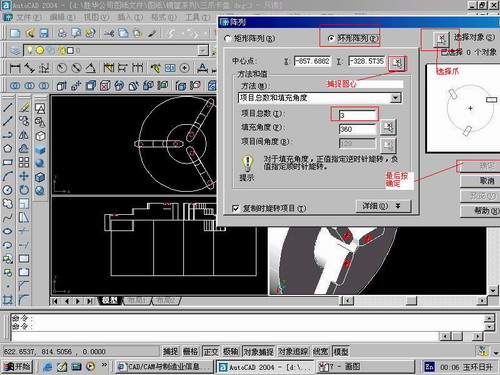
第四步,初步大致建立基本模型.可以在主视图建立两个不同的圆,在用ext拉升,在用差集运算.如图:
第五步:关键一步,在此的我思路是.先画出卡爪的基本投影,在把他进行面域,在进行拉升高度分别是10,20,30曾t形状.如图:
第六步:画出螺栓的初步形状.如图
第七步:利用ext拉升圆,在拉升内六边形.注意拉升六边行时方向与拉升圆的方向是相反的.
之后在利用差集运算
第八步:将所得内螺栓模型分别复制到卡爪上,在利用三个视图调到与卡爪的中心对称.效果如图红色的是螺栓,最后是差集
第九步:阵列
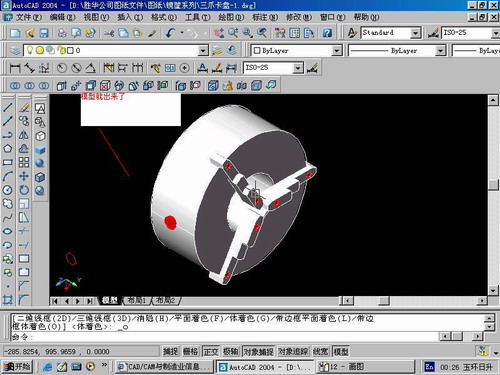
第10步.模型就完成了
来一张利用矢量处理的图片

说明:补充资料仅用于学习参考,请勿用于其它任何用途。
参考词条